
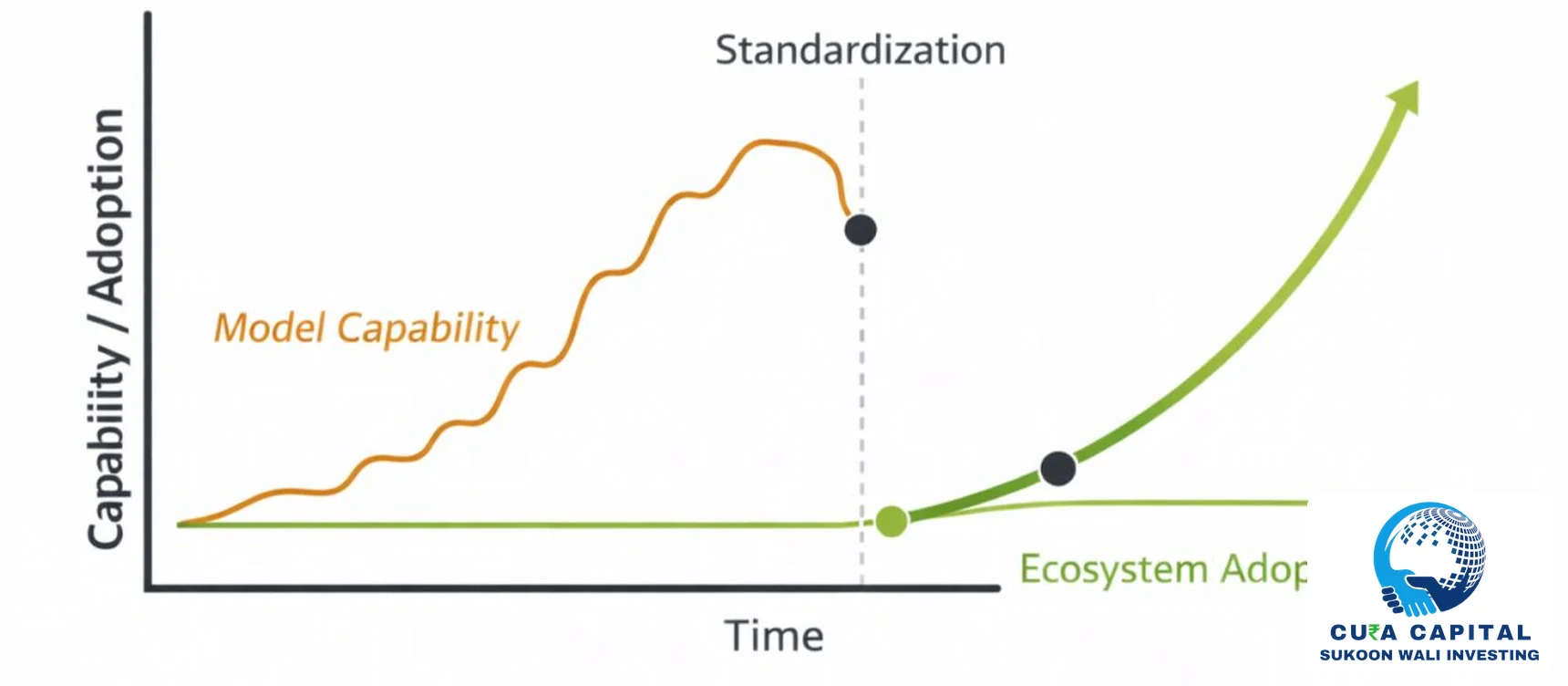
We obsess over model benchmarks. More tokens. Better reasoning. Higher scores. But AI adoption does not accelerate when models improve. It accelerates when integration becomes predictable.
This is part of the Hidden Variables in AI Strategy series — examining the factors that determine whether AI initiatives deliver real organisational value or remain stuck in perpetual pilot.
The Integration Uncertainty Problem
Today's AI landscape presents a fragmented integration picture. Different vendors use different API schemas. Safety and guardrail abstractions are inconsistent. Audit log formats are proprietary. Compliance assumptions vary by tool, by model provider, and by deployment context. Every new AI capability requires custom integration work. Every vendor evaluation feels risky because switching costs are high.
The result: even when a model clearly outperforms the status quo, teams hesitate. Because the question is not just "is this model good enough?" — it is "how much will it cost us to integrate, audit, and maintain this over time?" Uncertainty, not capability, is the bottleneck.
History's Pattern: Standards Enable Scale
This dynamic is not new. Every transformative technology went through the same phase — capability attracting early adopters, followed by fragmentation, followed by a standard that unlocked mass adoption.
| Technology | What Scaled It | What It Standardised |
|---|---|---|
| The Internet | TCP/IP protocol | Communication — how data packets are addressed and routed |
| Hardware peripherals | USB standard | Connectivity — one interface replacing dozens of proprietary ports |
| The Web | HTTP protocol | Interaction — how browsers and servers exchange requests and responses |
| Cloud infrastructure | REST APIs + OAuth | Integration — predictable authentication and data exchange patterns |
In none of these cases did scale come from the underlying technology becoming more powerful. It came from uncertainty being removed through standardisation. The same pattern is now playing out in AI.
From Inside Large Organisations
AI tools existed. Adoption did not — until standards were defined. When a common connector framework was introduced across teams, with predefined authentication patterns, standardised audit log formats, and consistent data boundary definitions, usage accelerated significantly. Not because models improved. Because integration risk dropped, confidence rose, and adoption followed.
Models create capability. Standards create composability. Composability creates scale.
The Composability Equation
Composability is the ability to combine AI capabilities without rebuilding from scratch each time. A model is composable when it can be integrated, audited, and replaced according to a predictable interface — when your compliance patterns work across vendors, when your audit logs are readable by your security team regardless of which model generated them, when swapping one provider for another does not require rewriting your entire integration layer.
Without composability, organisations are locked into whichever AI they first integrated. The switching cost is too high. New capabilities cannot be layered. The ecosystem stagnates — not because better options do not exist, but because the cost of accessing them is prohibitive.
With composability, each new AI capability becomes additive rather than disruptive. Teams can experiment, evaluate, and swap without systemic risk. The ecosystem grows.
Assessing Your AI Readiness
When evaluating AI readiness, don't just ask "is the model good enough?" Ask your team:
- Can we integrate without custom work every time? If each new AI tool requires bespoke engineering, your integration layer lacks standards — and adoption will remain low regardless of model quality.
- Can we switch vendors without rewriting systems? Vendor lock-in is a proxy for the absence of standards. If switching costs are high, your architecture is built around a product, not a protocol.
- Are compliance and audit patterns reusable? Reusable audit patterns mean your governance overhead does not multiply with every new AI deployment.
- Does interoperability exist across teams? If the data science team's AI outputs cannot be consumed by the engineering team's systems without translation work, you have an interoperability gap that standards would close.
The Bottom Line
The real AI inflection point will not be a larger model or a better benchmark. It will be when integration stops feeling experimental — when teams can compose AI capabilities the way they compose cloud services today: predictably, reliably, and without rebuilding the plumbing every time.
Uncertainty stalls ecosystems. Standards reduce uncertainty. And ecosystems are what scale. The organisations that invest in standardising their AI integration layer now — not just evaluating the best model — will be the ones that compound their AI investments over time rather than starting from scratch with each new wave of capability.
Disclaimer: The views expressed are those of the author and are for informational purposes only. They do not constitute financial, legal, or investment advice.