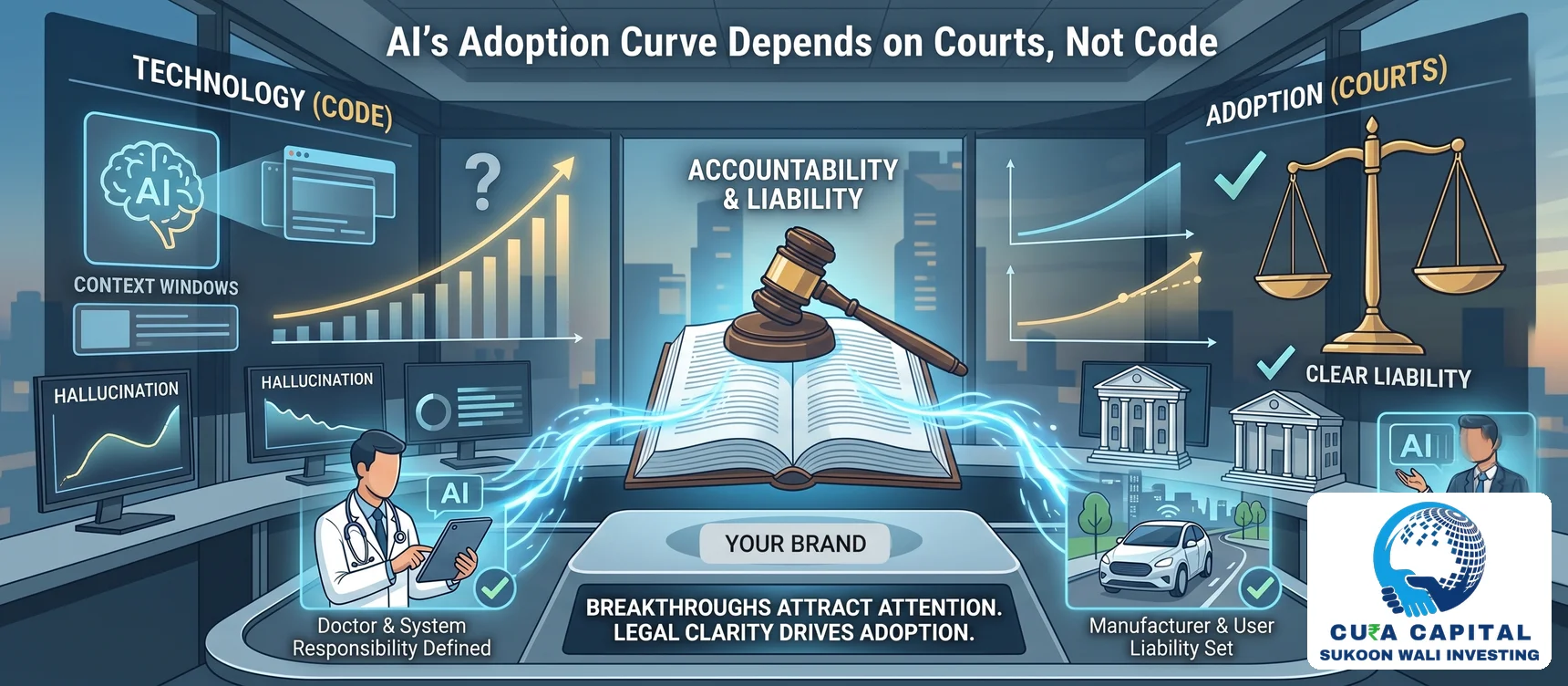

Models are getting better. Smarter reasoning. Fewer errors. But that is not what is limiting AI adoption — explainability is. The gap between a model that is accurate and a model that is actually used in real workflows is widening, not narrowing. And closing it requires a fundamentally different lens on what we mean by a "good" AI system.
This piece is part of the Hidden Variables in AI Strategy series — examining the factors that determine whether AI initiatives deliver real organisational value or remain stuck in perpetual pilot.
The Accuracy Paradox
This is not a new problem. The moment AI moved from simpler, rule-based models to deep neural networks, we gained accuracy — and lost interpretability. But for years, the impact was contained. Building AI systems required specialists who could navigate the trade-off, and the outputs typically informed human experts rather than replacing their judgment.
That changed with LLMs and prompt-driven, agentic AI. Anyone can now deploy AI into real workflows — customer service, loan underwriting, clinical decision support, hiring. The barrier to building dropped to near zero. But the barrier to trusting what gets built did not.
Which means the explainability gap is no longer technical. It is operational. AI is now making decisions that affect people. And in those domains, accuracy alone is not enough.
Where the Gap Costs the Most
Healthcare
If an AI system suggests a diagnosis, the clinician needs to understand why. Not just the conclusion — the reasoning. Doctors will not act on a black-box recommendation, regardless of its accuracy rate. Hospitals will not deploy systems without traceability, because liability requires it. Even advanced systems like Claude's medical reasoning or Microsoft's NHS pilots are evaluated not just on diagnostic accuracy, but on how clearly decisions can be explained and audited.
A correct answer without reasoning is not usable in a clinical setting.
Finance
If a loan application is rejected, the decision must be explained — to the customer, and to the regulator. This is not optional. Without explainability:
- Bias cannot be detected or challenged
- Decisions cannot be audited
- Regulatory compliance breaks down
- And adoption stalls, regardless of how accurate the model is
The same logic applies to credit scoring, insurance underwriting, algorithmic trading, and any domain where decisions affect people's lives or livelihoods.
From the Field
We deployed AI in decision-support workflows where outputs had real operational impact. The model performance was within expected parameters. But teams hesitated to act on the recommendations. The reason: they could not see how the decision was made. Once we added structured explanations — key signals, contributing factors, confidence levels — usage increased significantly. Not because the model improved. Because confidence did.
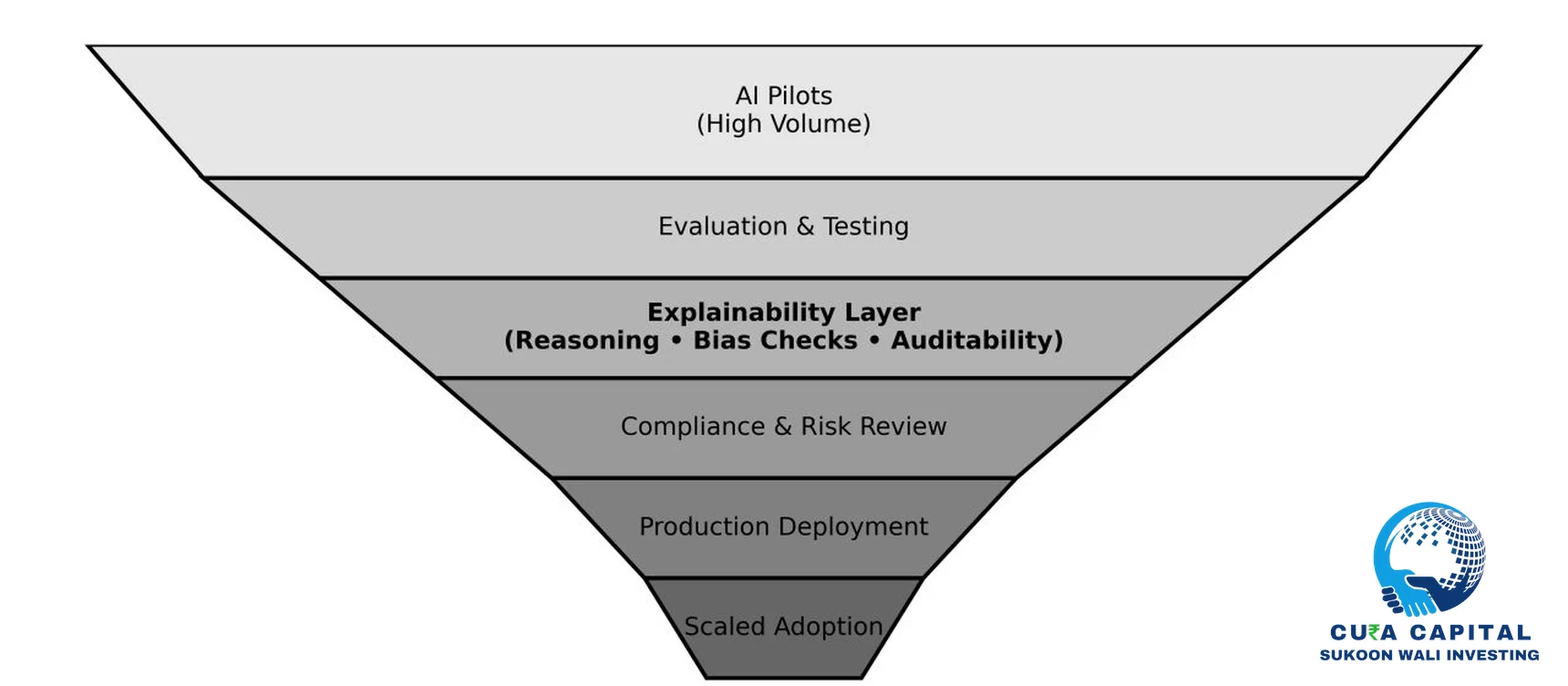
Accuracy gets you to pilot. Explainability gets you to production.
The Tools: XAI Approaches and Their Limits
Explainable AI (XAI) emerged precisely to address this trust gap. Early approaches — LIME (Local Interpretable Model-agnostic Explanations) and SHAP (SHapley Additive exPlanations) — were designed to answer one question: which inputs influenced this decision?
They are useful starting points. But they explain signals, not reasoning. They tell you which features mattered; they do not tell you how the model combined them, or whether the logic would hold under different conditions.
As we move to LLM-driven and agentic systems, the bar is higher. The questions decision-makers are now asking:
- What specifically drove this output?
- Can the reasoning be independently reviewed?
- Can bias in the decision chain be detected?
- Can each step be traced back to source data?
If those questions cannot be answered clearly, the system will not scale beyond a proof of concept. Structured chain-of-thought outputs, audit logs, and confidence intervals are becoming minimum requirements for production deployment — not nice-to-haves.
Regulation Is Already There
The European Union Artificial Intelligence Act mandates transparency, explainability, and bias safeguards for high-risk AI systems — systems used in healthcare, employment, education, credit, and critical infrastructure. This is not a future concern. The Act is in force, with phased compliance deadlines that major organisations are already navigating.
In high-stakes decisions, accuracy is not sufficient. The decision must be defensible — auditable, traceable, and explainable to affected parties, oversight bodies, and courts if necessary. AI systems that cannot meet this bar will not be permitted to operate in these domains within the EU, and similar frameworks are emerging globally.
What This Means for AI Strategy
Explainability should not be an afterthought, bolted on after a model reaches acceptable accuracy. It needs to be a design criterion from the start — part of the system architecture, not a post-hoc layer.
For organisations building or procuring AI systems for high-impact workflows, the questions to ask are:
- Can the system articulate why it produced a specific output?
- Can that reasoning be audited by a non-technical reviewer?
- Is there a mechanism to detect and correct for bias?
- Does the system meet the explainability requirements of applicable regulations?
If the answer to any of these is no, you have an accuracy problem masquerading as a deployment problem.
The Bottom Line
Don't just ask: "Is the model right?" Ask: "Can we explain why it's right?" Because the moment decisions matter — when they affect a patient's care, a family's finances, or a person's employment — you will not adopt what you cannot explain. The organisations that internalise this early will deploy AI that actually gets used. The rest will accumulate impressive pilot results and stagnant adoption curves.
Disclaimer: The views expressed in this article are those of the author and are intended for informational purposes only. This is not financial, legal, or regulatory advice. AI regulatory requirements vary by jurisdiction and are subject to change. Readers are advised to consult qualified legal and technical advisors for their specific circumstances.