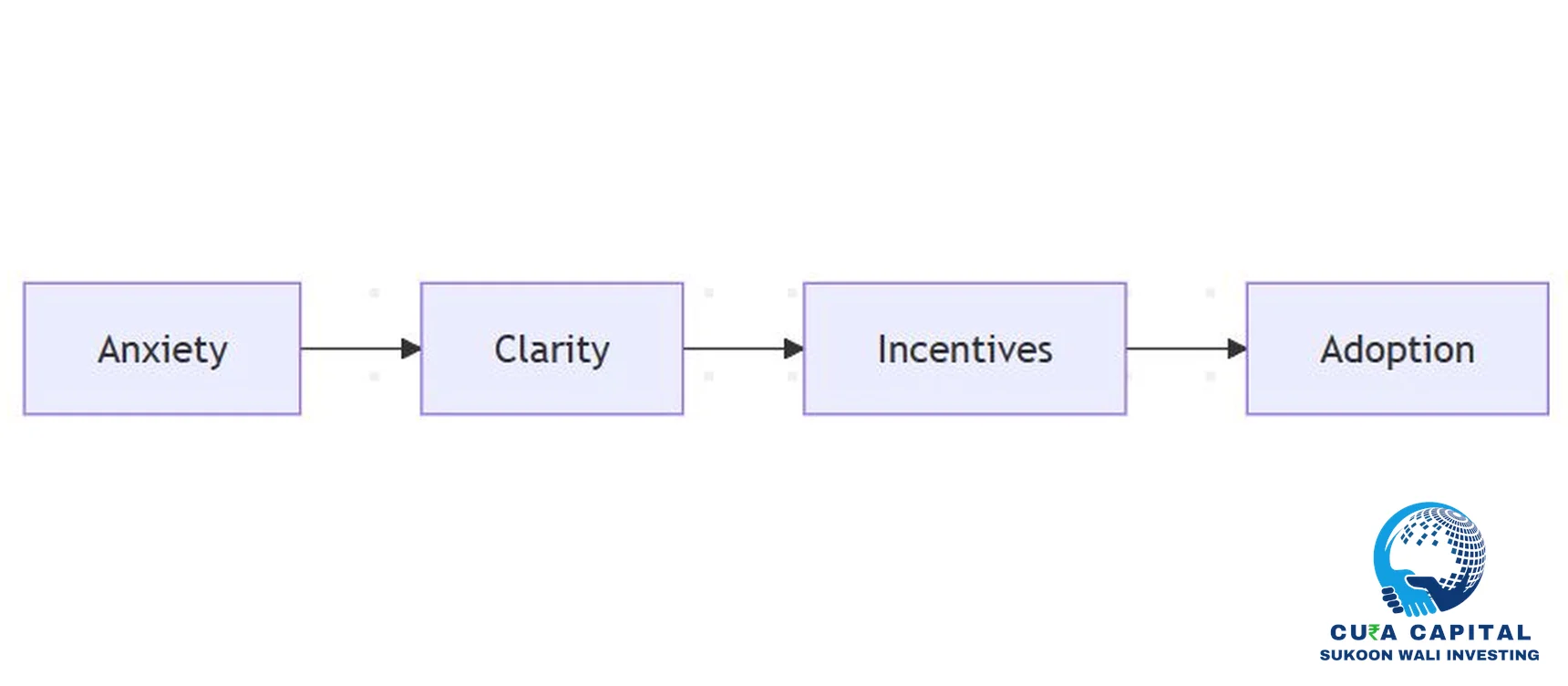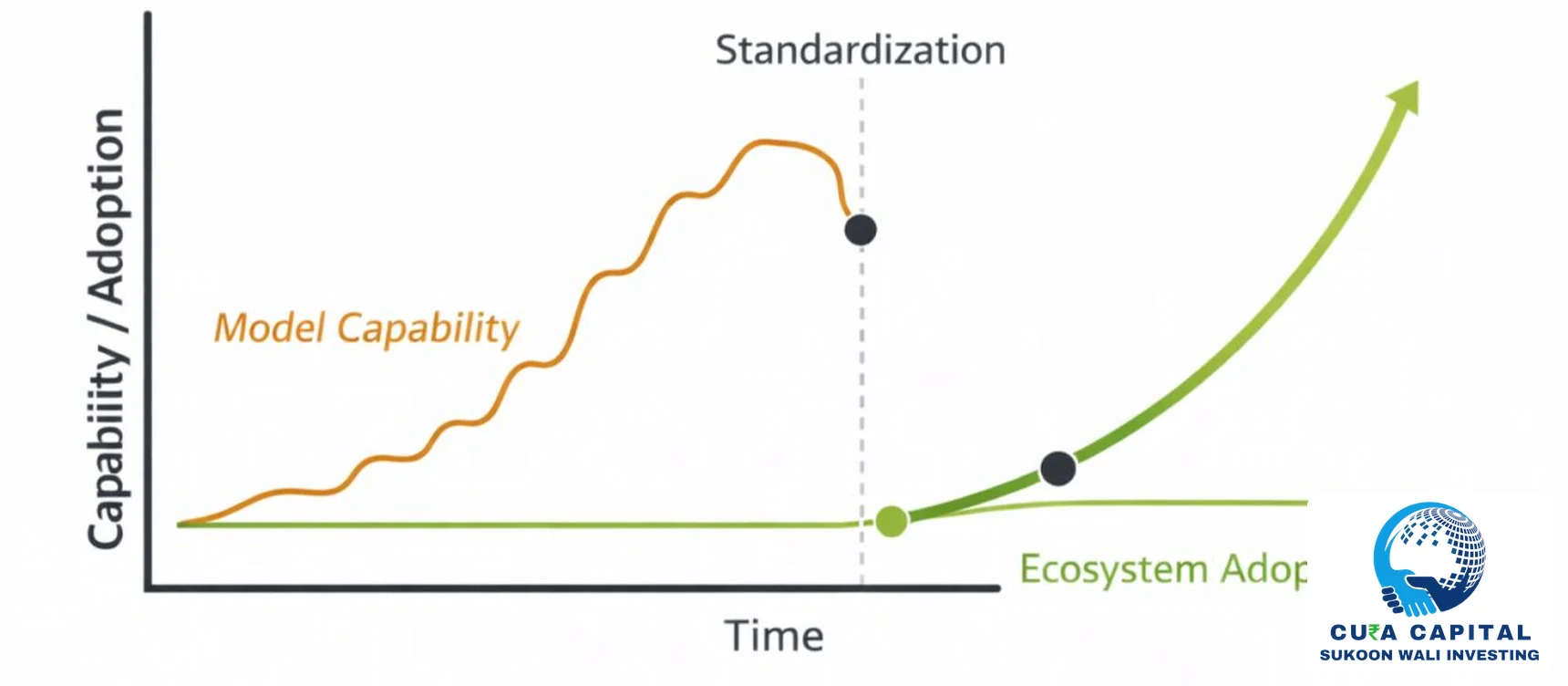

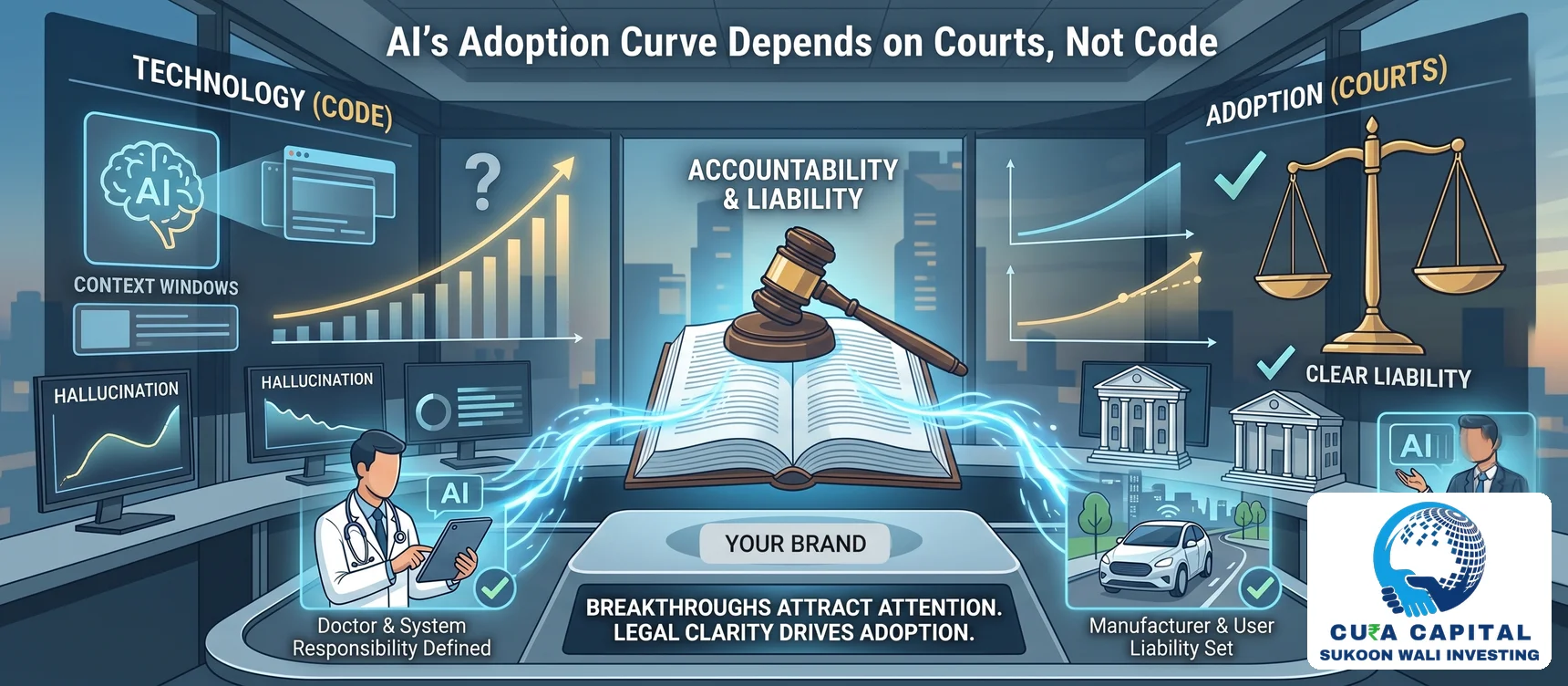
Everyone is watching AI model benchmarks. Bigger context windows. Smarter reasoning. Lower hallucination rates. But what if that is not the bottleneck in adoption? What if the real constraint is not capability — but accountability?
Technology does not only scale when it improves. Its adoption grows exponentially when responsibility becomes clear.
History Leaves Clues
Two examples illustrate the pattern well.
Social platforms accelerated after US Code Section 230 clarified that platforms were not liable for user-generated content.1 That single piece of legal certainty unlocked a wave of investment and growth that better technology alone could not have produced. Platforms already existed. What changed was clarity about who was responsible when things went wrong.
Gun manufacturers in the United States have largely been shielded from liability for crimes committed with their products under the Protection of Lawful Commerce in Arms Act.2 Whether or not one agrees with the policy, the pattern is the same: the shape of legal responsibility shaped the shape of the industry — its scale, its distribution, its product decisions.
In both cases, what changed was not the technology. What changed was who bore the cost of harm. And that change determined the adoption curve.
AI's Unresolved Question
AI has a simple, deeply unresolved question at its core: if something goes wrong, who pays?
The Liability Gap
If a doctor misdiagnoses you, the doctor is liable — not the textbook publisher. But if that doctor relies on an AI system built by Anthropic or OpenAI and makes an error, where does responsibility sit? The company that trained the model? The organisation that deployed it? The professional who relied on it? Right now, there is no consistent, predictable answer.
This ambiguity is not a theoretical problem. It is a practical adoption barrier. Organisations deploying AI in high-stakes contexts — healthcare, law, financial advice, infrastructure — cannot price the tail risk of an AI-caused error if liability is unclear. Insurance markets cannot adequately cover it. Legal teams cannot advise confidently on it.
The result is caution. Pilots that do not scale. Careful procurement processes that slow deployment. Vendor contracts loaded with indemnity clauses that reflect the legal vacuum rather than resolve it.
Breakthroughs attract attention. But legal clarity is what actually drives adoption.
Where Is This Playing Out?
Consider the sectors where AI adoption has been most measured despite compelling capability:
- Autonomous vehicles: The technology has existed in demonstration form for years. Regulation — and the unresolved question of who is liable in an accident — remains a primary constraint on deployment at scale.
- Robotics in the workplace: As robots take on physical tasks alongside humans, injury liability frameworks are being tested in ways that existing law was not designed to handle.
- AI financial advisors: Algorithmic financial recommendations sit in a regulatory grey zone between software and regulated financial advice, with significant implications for fiduciary liability.
In each case, adoption is not waiting for better technology. It is waiting for clearer legal frameworks that define who is responsible when outcomes fall short.
The Bottom Line
AI capability is accelerating. Legal frameworks are lagging. That gap — between what AI can do and what organisations can confidently deploy — is where adoption friction actually lives.
The organisations and jurisdictions that move fastest on liability clarity will attract the most AI deployment. Not because they have better models, but because they have lower uncertainty. And in any complex system, reducing uncertainty is what unlocks scale.
That ambiguity may slow AI adoption in high-stakes sectors more than imperfect accuracy ever will. Breakthroughs attract attention. Legal clarity is what actually drives adoption.
References
- Section 230 overview — Cornell Law School
- Protection of Lawful Commerce in Arms Act (PLCAA) — U.S. Congress
Disclaimer: The views expressed are those of the author and are for informational purposes only. They do not constitute financial, legal, or investment advice.