
Most AI conversations begin with the same framing: cost of implementation versus return on investment. Budget versus productivity. Spend versus savings. It sounds rational. It has worked before. But is it the right conversation in the AI era?
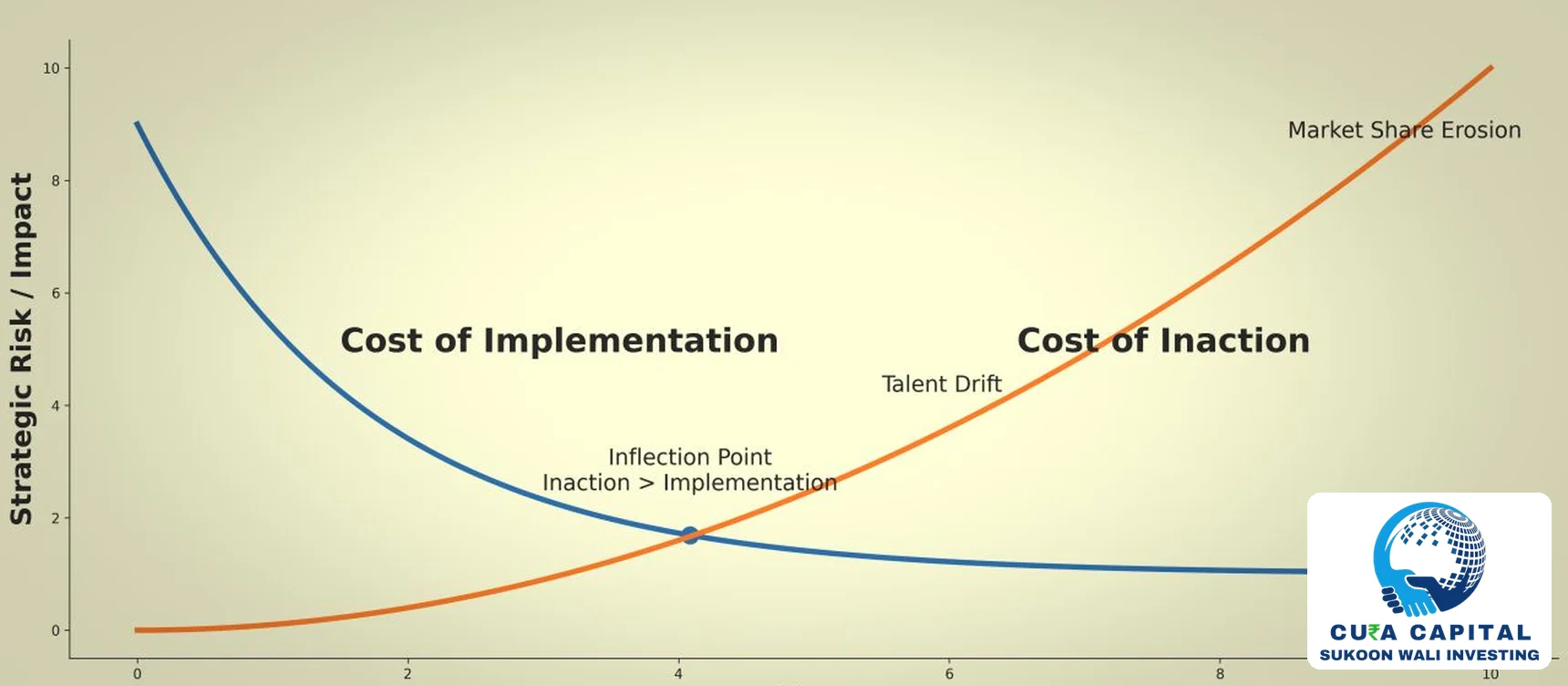
Perhaps the better comparison is: cost of implementation vs cost of inaction.
This is part of the Hidden Variables in AI Strategy series — examining the factors that determine whether AI initiatives deliver real organisational value or remain stuck in perpetual pilot.
Two Very Different Cost Structures
Implementation costs are visible:
- Budget and new tooling
- Workflow redesign
- Retraining costs
- Governance overhead
They feel heavy because they are immediate. They show up on budget lines. They require approvals. They generate resistance.
Inaction costs are subtle:
- Your product is no longer the obvious choice
- Margins compress while others automate
- Turnaround times stretch as competitors accelerate
- Internal teams using AI start outperforming those that aren't
- Customers quietly shift preference
You don't lose loudly. You become less relevant. And relevance loss doesn't trigger alerts. It doesn't appear on dashboards. It compounds slowly — until suddenly it's the story everyone is telling about you.
What Actually Triggers AI Adoption in Large Organisations
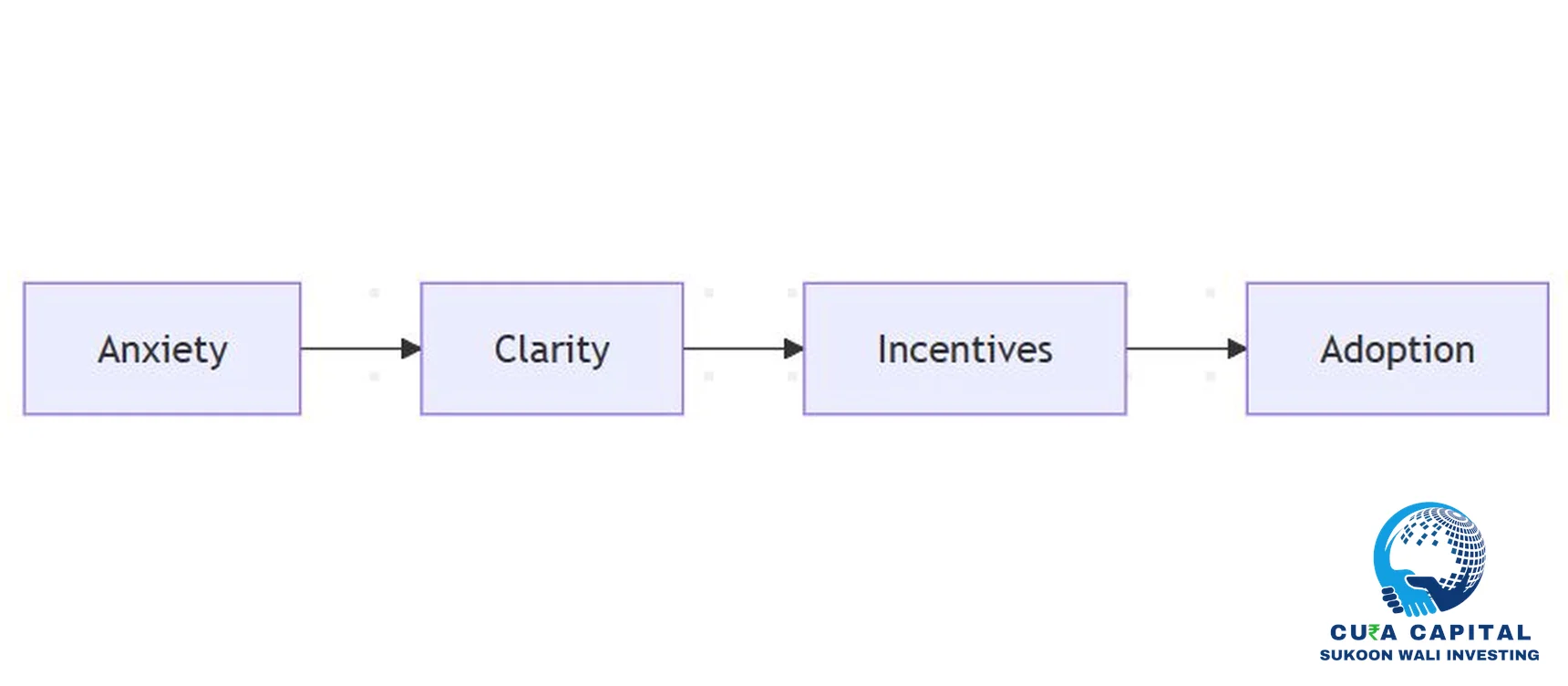
In large organisations, the pattern is consistent. AI adoption rarely accelerates because an ROI calculation looks compelling. It accelerates when:
The Actual Triggers
A sister team starts taking over your share of work because they are using AI and delivering faster. A competitor operates at half your cost base by automating what you do manually. A startup attacks your core market with AI leverage — not better product design, just faster iteration at lower cost. At that point, the ROI conversation ends. The survival conversation begins.
This is not a new phenomenon. The mechanism is familiar from every major technology transition.
When Netflix moved to streaming, incumbents like Blockbuster did not collapse overnight — they faded. Revenue declined gradually. Store closures followed. The end looked sudden only in retrospect; the process was slow and entirely predictable.
When Canva simplified online design, it quietly reset user expectations. Design professionals who had spent years mastering complex tools found that clients no longer valued that complexity. The tool that once signalled expertise became a bottleneck.
Consumer markets are even harsher. Users don't complain. They switch silently, before you can even realise the preference has shifted.
Adoption curves bend when standing still becomes riskier than moving imperfectly.
The Diagnostic Questions
If your team is still debating whether AI is "ready," the more useful questions are:
- Are we matching competitor velocity? If competitors are delivering the same output faster or at lower cost, the gap is already opening. The question is not whether to respond — it is whether you will respond before or after the gap becomes structural.
- Are customers experiencing friction others have removed? If a competitor has eliminated a pain point that you still have, your customers are noticing — even if they haven't told you yet. Silent preference shift is the most dangerous form of churn.
- Are we defending legacy comfort while the market resets expectations? The most dangerous position is not ignorance of AI — it is active resistance to it, justified by the fact that existing processes "still work." They will, until suddenly they won't.
The Bottom Line
In every major technology shift, implementation feels expensive. Inaction compounds silently — until it shows up as irrelevance.
AI adoption will accelerate the moment standing still becomes strategically dangerous. For some organisations, that moment has already passed. For others, the window is still open — but it is narrowing. The organisations that treat the cost of inaction as real, tangible, and compounding — not as a vague future risk — will be the ones that move while the window is still open.
Disclaimer: The views expressed are those of the author and are for informational purposes only. They do not constitute financial, legal, or investment advice.